From Taste Washing to Front Row
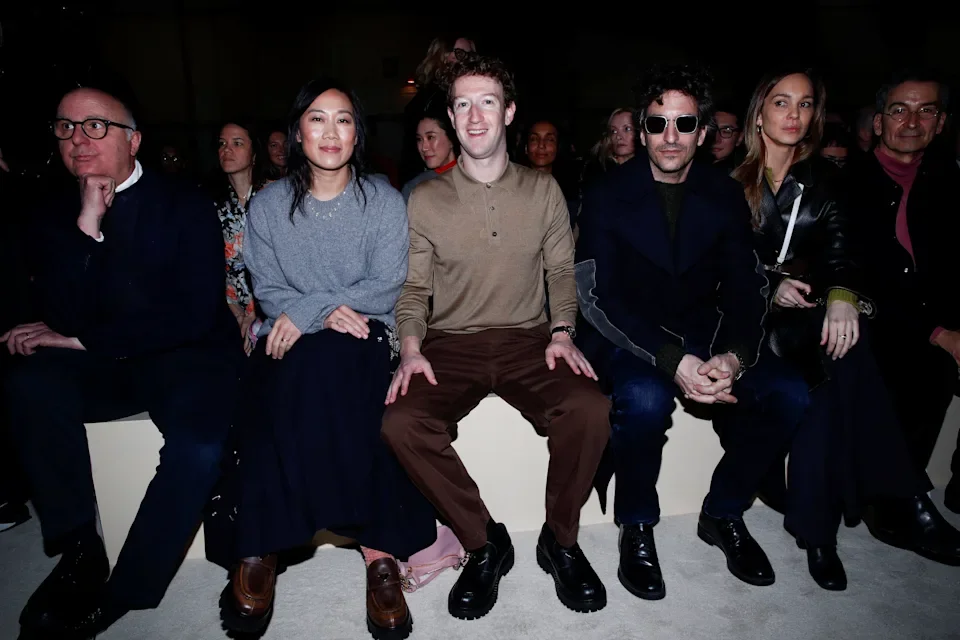
"The celebrity face did not appear from nowhere. In the autumn/winter 2026 shows, Mark Zuckerberg sat in the front row at Prada in Milan, Jeff Bezos at Dior, and longevity entrepreneur Bryan Johnson walked the runway for Matières Fécales."

In June 2026, Meta put Kylie Jenner’s face on its smart glasses. The new range, made with EssilorLuxottica, the eyewear group behind Ray-Ban, included an oval frame designed with Jenner herself.[1] The partnership, as the press put it, has sold millions of units “bringing AI into everyday life.”[1]
For a few years, tech tried to look tasteful. It wrapped its devices in fabric and spoke softly in pastel and white. This article calls that taste washing: using beauty, craft and culture to make a technology, and the power behind it, feel humane. The runway and the Jenner campaign are something else. They are not a wash but evidence: a flashing truth, where the intent shows through in plain sight. A camera and an AI assistant are now sold on one of the most famous faces in the world, as a fashion accessory you wear all day.
This Substack is reader-supported. To receive new posts and support my work, consider becoming a free or paid subscriber.
The answer: “We’re always watching”
The reply came within weeks. In July 2026, the UK activist group Everyone Hates Elon installed a lenticular poster at a bus stop near Meta’s London headquarters. From one angle, it showed Jenner in the glasses. From another, it showed an X-ray skull and the line “We’re always watching.”[2]
“Meta has spent years tracking us online,” the group said. “Now it wants to track us in the real world too.”[2] It also raised the risk of women being recorded without consent, and asked: “Billionaires could fund cures for cancer — so why are they funding glasses for perverts instead?”[2]
The poster does in one image what this article sets out to do: turn the beautiful surface and show what is underneath.
“Everyone Hates Elon installed a lenticular poster at a bus stop near Meta’s London headquarters”
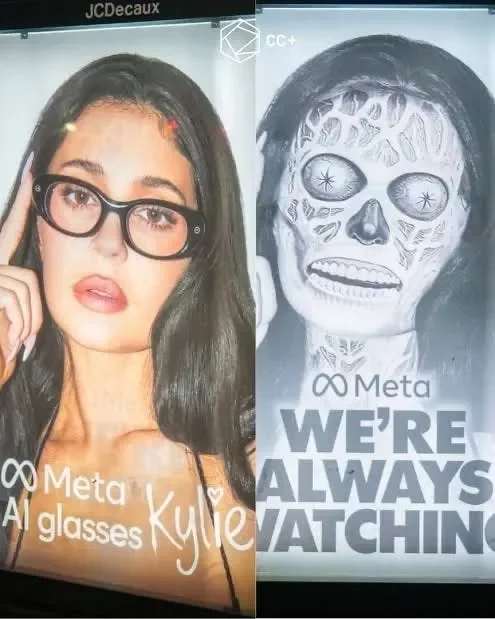
Before: the subtle wash
The idea is older than the campaign. In 2022, designer Vicky Gu gathered writer Kelly Pendergrast, critic Kyle Paoletta and photographer Behzod Sirjani to talk about “The Aesthetics of Tech.” Gu warned that “nicely packaged corporate communications have a history of smartwashing the gritty truth,” and asked: “Like greenwashing, but make it privacy?”[3]
Their subject was the quiet version. Smart speakers arrived dressed as furniture. Google’s Isabelle Olsson, quoted in the piece, wanted products to “become so natural in your life that you don’t think about them as technology anymore.”[3] Pendergrast described “technology that is designed to obscure itself” and wrote of the “luscious textiles” wrapped around it. “With cloth comes a long history of labor, industry, computation, commodity fetishism, and fantasy,” she wrote. “It’s never just cloth.”[3]
The group set these black boxes against honest objects. Paoletta recalled Pendergrast’s essay on her OXO corkscrew, a tool that shows you why it broke; Gu bought a Marshall, a “stupid beautiful speaker” with no smart features at all.[3]
From the AI speaker to the face
Gu’s group already had Meta’s glasses in view. In 2022 they noted that Ray-Ban Stories tucked a camera into a classic frame, and that the privacy worries that sank Google Glass seemed to stick less to them.[3]
Four years on, the move is complete. The fabric on the speaker has become the frame on the face, and the frame now carries a celebrity’s name. The 2022 wash hid the machine inside a familiar object. The 2026 campaign does not hide it at all. It makes the camera and the assistant desirable by attaching them to Jenner, and asks us to wear them everywhere, all day. It is a flashing truth: the wash no longer covers the machine, it advertises it. That is the shift in the title: from taste washing to a less subtle push to the AI agenda.
The front row
The celebrity face did not appear from nowhere. In the autumn/winter 2026 shows, Mark Zuckerberg sat in the front row at Prada in Milan, Jeff Bezos at Dior, and longevity entrepreneur Bryan Johnson walked the runway for Matières Fécales.[4]
A March 2026 essay, “Tech billionaires are turning fashion week into a Silicon Valley brotherhood,” reads the presence as strategy. To turn money into cultural power, tech elites “must align themselves with the cultural foundations of society: creativity, aesthetics and taste.”[4] The runway answered with power shoulders, sharp tailoring and 1980s Wall Street codes. “The suit, after all, is not just a garment but a piece of social technology,” the essay notes, one that signals “competence, discipline and authority.”[4]
Fashion has always worked as a smoke curtain: a velvet rope that convinces everyone outside that something marvellous happens on the other side. Lift it and you find a room, some chairs and a seating chart. And fashion, which never misses a chance to laugh at its audience, laughed at this one too. It dressed the new kings as Patrick Bateman, in power shoulders and Wall Street tailoring, the uniform of a satire its wearers took as a compliment. The essay notes that Bateman’s morning routine now reads like ordinary tech influencer content.[4] The joke was on the front row, and the front row applauded.
So the runway is not taste washing; it is evidence. Zuckerberg at Prada for the winter shows, Jenner in Meta’s frames by June: the front row shows, in plain sight, who is aligning with whom, and the campaign is what that alliance sells. It is a flashing truth, not a disguise. And like every season, it will not last. Fashion crowns its guests for exactly as long as it finds them amusing.
“Zuckerberg at Prada for the winter shows”
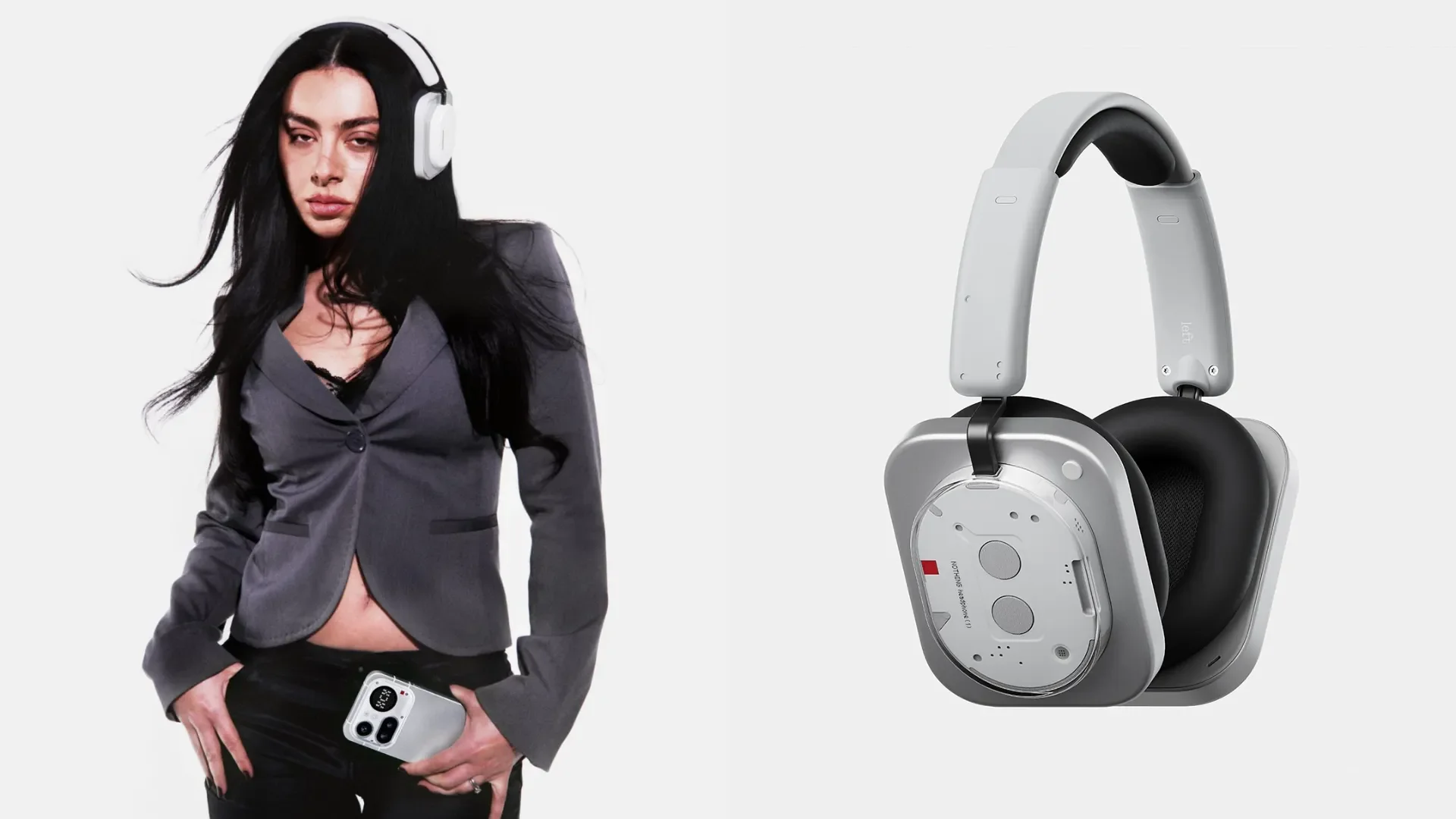
The counter-model: Nothing
Not every tech brand hides the machine or sells it on a face. Nothing opens its site with a promise: “We’re building a world where tech is fun again. Remember a time where every new product made you excited?”[5] Its phones and earbuds are known for see-through shells that put the components on display, the opposite of the fabric camouflage Gu’s group described.
Nothing trades on culture too. V is the global brand ambassador for Headphone (1) Pro, and Charli XCX fronts a battery-testing campaign.[5] The difference is direction. Meta uses Jenner to sell the camera as style; Nothing uses its stars to point back at the product. The risk is that “fun tech” becomes a costume of its own.
The test: Apple’s design principles
On 8 June 2026, weeks before the Jenner launch, Apple reintroduced the design principles in its Human Interface Guidelines.[6] They are eight short commands, and their order is the argument:
Purpose: “Make something meaningful.”
Agency: “Let people do things their own way.”
Responsibility: “Act in people’s best interest.”
Familiarity: “Build on what people know.”
Flexibility: “Adapt to diverse contexts and needs.”
Simplicity: “Be clear and direct.”
Craft: “Care about every detail.”
Delight: “Make it human.”[6]
Craft and Delight, the qualities a washed brand leads with, come last. What comes first is what the product is for and whom it serves. Responsibility asks makers to “be fully transparent about what your product does and why” and to “be clear about what you collect and how you use it.”[6] Two more lines read like a reply to the soft-tech look: “Simplicity isn’t minimalism” and “Don’t mistake delight for decoration.”[6]
Hold the Jenner campaign up to that list. A celebrity frame scores on Craft and Delight. The poster outside Meta’s office is a question about Responsibility: what does a camera on your face collect, and who is it for? A launch that leads with the face and leaves that question to activists fails the test in Apple’s own terms. The tension is that Apple is also the template others borrow; its principles are a standard it can be measured by as well.
The softer push and the grander one
The campaign sits between two other moves of the same year, one quieter and one louder.
The quieter one is colour. Palettes are going back to pastel, and the colour of the year is white: Pantone’s Cloud Dancer, its first white ever.[8] It is the palette of an oversaturated world that needs to disconnect. Pantone’s Leatrice Eiseman put it plainly: “The cacophony that surrounds us has become overwhelming.”[8] Yet soft pastels and clean white are already the face of the interfaces that make the noise. A white page promises the disconnection that an always-on camera works against.
The louder one is the palace. In October 2025, the East Wing of the White House came down to make way for a ballroom, and the bill went to the guest list. The project is privately funded, and the published donors include Apple, Amazon, Google, Meta, Microsoft and Palantir.[11] Watch it as a show and the plot turns. This time the front row is not in the audience. It is on the invoice.
This article reads the ballroom less as a monument to tech than as an exposure of it. A president who builds in marble does not need to believe the tech oligarchy will last two thousand years; he only needs everyone to see who paid. Joan Walsh, in The Nation, calls the run of images from that autumn “psychologically destabilizing—and they are intended to be.”[7] Intended for whom is the real question. Put the oligarchs’ names on the wrecking ball and their power stops being quiet. A cover-up dictatorship needs its patrons in the shadows; this one prints the seating chart. Power that is seen can be handed on to the next generation, instead of being kept, unseen, by the few who bought it.
Betty Ford once said: “If the West Wing is the mind of the nation, then the East Wing is the heart.”[7] The heart came down, the donor list went up, and for once the front row paid for its own seats.
Image of White House’s East Wing Demolition
Science Fiction
Imagine you have not been in a room with another person for months. You don’t need to be. Your frames wake you with a famous voice, read your messages and tint the world a soft white when it gets too loud. At dinner your sister appears across the table, sharp enough to touch, though she is eating in her own kitchen four hundred kilometres away; you do not visit her, you view her, and visiting has started to feel crude. Everything you look at, your frames remember, so everyone is recorded and no one is really there. Isaac Asimov imagined this world in The Naked Sun (1957): on Solaria, twenty thousand people live alone among millions of robots, never “seeing” each other, only “viewing”, and only the detective Elijah Baley, raised in Earth’s crowded cities, still wants to be in the room.[10] In 2026, the question is whether any of us will still want to take the frames off.

Closing: no longer subtle
Taste washing asked us to forget the machine. A soft fabric, a calm palette, a white page: each made technology feel like something else. The runway and the Jenner campaign are not part of that wash. They are evidence, a flashing truth: the camera is not hidden, the agenda is not disguised, and the AI comes as part of a look. For once, the surface tells us exactly what it is for.
Taste is not the enemy. The corkscrew, the honest speaker and the see-through phone show that design can tell the truth about what a thing is, and Apple’s own guidelines say delight is not decoration.[6] The push becomes a problem when the face is asked to do the work the product will not: to answer, with glamour, a question about what is being recorded and why. Gu’s 2022 resolution still holds. Enjoy the beauty, and keep vibrating with unease.[3]
References
Milano Finanza, “Kylie Jenner firma gli smart glasses di Meta”, 30 June 2026.
Rhea Nayyar, “Guerrilla London Bus Ads Mock Kylie Jenner’s Meta Glasses Campaign”, Hyperallergic, 15 July 2026.
Vicky Gu, with Kelly Pendergrast, Kyle Paoletta and Behzod Sirjani, “The Aesthetics of Tech”, 25 January 2022.
“Tech Billionaires are Turning Fashion Week into a Silicon Valley Brotherhood”, Substack, 8 March 2026. Author name to confirm.
Nothing, brand website, accessed 2 October 2026.
Apple, “Design principles,” Human Interface Guidelines, reintroduced 8 June 2026.
Joan Walsh, “The Crazy-Making Destruction of the East Wing of the White House”, The Nation, 24 October 2025.
Smithsonian Magazine, “Pantone’s Color of the Year for 2026 Is a Blank Canvas Called Cloud Dancer”, December 2025. Outside your sources; keep or cut.
Times of India, “Taste washing: How big tech is redefining luxury through aesthetics”.
Isaac Asimov, The Naked Sun, Doubleday, 1957.
NBC Washington, “Donors to the White House ballroom”, 23 October 2025.
This Substack is reader-supported. To receive new posts and support my work, consider becoming a free or paid subscriber.