Political Fashion: À la guillotine
"À la guillotine" is this article's framing, not the brand's. But the setting invites it: Place de la République is where Parisians gather for every major protest, and a crowd parading the rich on its shoulders around a revolutionary monument needs little translation.
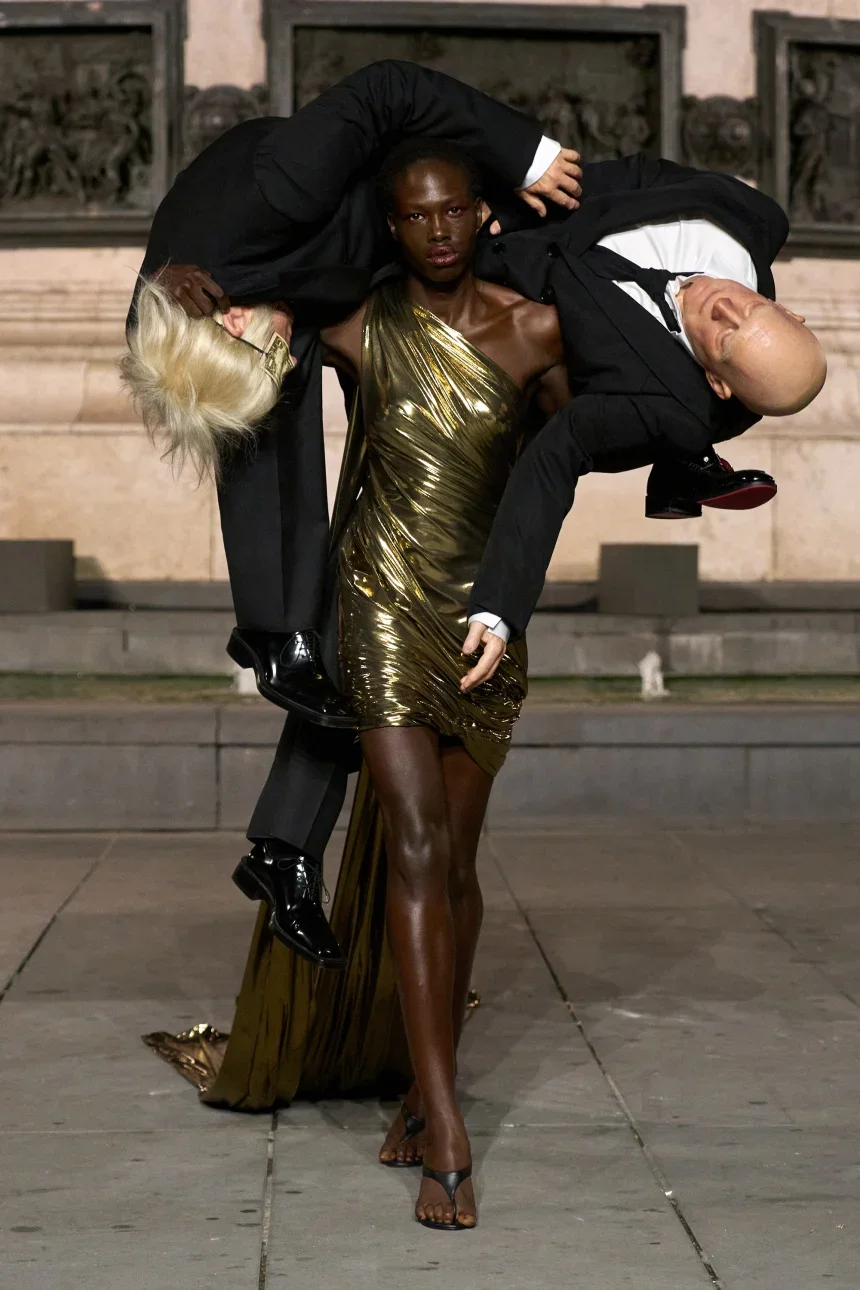
The 1% , Matieres Fecales, Paris FW 2026
Two shows, one verdict
In 2026 Matières Fécales split the economy in two and gave each half a runway. In March, "The One Percent" (Fall/Winter 2026) put the elite on stage at La Bourse, the former Paris stock exchange. On 28 September, "The Ninety Nine Percent" (Spring/Summer 2027) took the opposite side to Place de la République, with 99 models of colour, many of them friends and family of the designers (Hypebae).
Read together, the two collections work as a diptych: first the portrait of the rich, then the crowd that outnumbers them. The finale makes the point literal. Models circled the statue of the Republic carrying life-size billionaire figures on their backs (Hypebae).
The duo, Hannah Rose Dalton and Steven Raj Bhaskaran, root the theme in their own backgrounds. In the FW26 show notes, Bhaskaran contrasts his childhood in Cartierville, one of Montréal's poorest districts, with Dalton's in Westmount, one of its richest (Fucking Young!). SS27 draws directly on his upbringing in Montréal social housing (Hypebae).
"À la guillotine" is this article's framing, not the brand's. But the setting invites it: Place de la République is where Parisians gather for every major protest, and a crowd parading the rich on its shoulders around a revolutionary monument needs little translation.
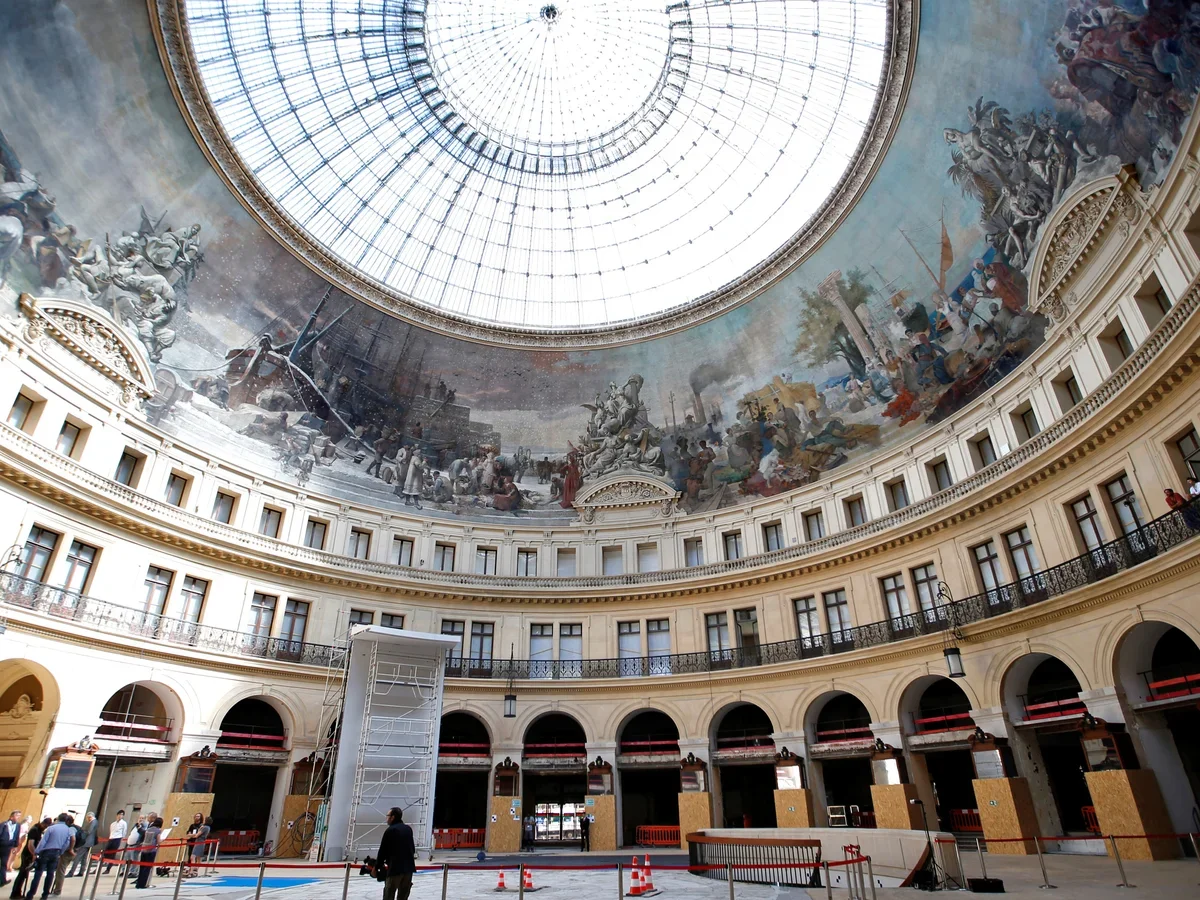
Former Paris Stock Exchange
The call of intentions: Bryan Johnson on the runway
The sharpest move in "The One Percent" was a casting choice. In the closing "immortals" tableau, Michèle Lamy walked in a floor-length grey knit. Bryan Johnson, the longevity-obsessed biohacker, followed in a plain, skin-tight grey knit (10 Magazine). It was his runway debut (Glamcult).
Johnson is not a model playing a rich man. He is the real thing. He made his fortune selling Braintree to PayPal for $800 million (Open). In 2026 he launched "Immortals", a top-tier version of his anti-ageing protocol, with his fortune estimated at $200–400 million (Spider's Web).
That is the brand's call of intentions: in a collection about the one percent, it did not caricature the elite, it invited one of them to walk. Lamy, who embraces ageing, followed by Johnson, who spends millions to avoid it, is a pairing that comments without a caption. Glamcult openly wondered whether Johnson understood what he was part of.
Tone and register. This is where Matières Fécales differs from most "political" fashion. The register is deadpan, not didactic:
No slogans. The critique sits in casting, props and venue: a stock exchange, a "Blinded by Money" leather mask (Russh), red-palmed "Guilt Gloves" suggesting blood on wealthy hands (10 Magazine).
Complicity on display. Inviting a billionaire makes the elite a participant, not just a target. The audience cannot tell whether he is the joke or in on it, and that ambiguity is the point.
First person. The show notes speak from the designers' own class history, not from an abstract manifesto.
Open question: I found no statement from the brand or from Johnson explaining the invitation. Reading it as intentional critique is an interpretation, not a documented claim.
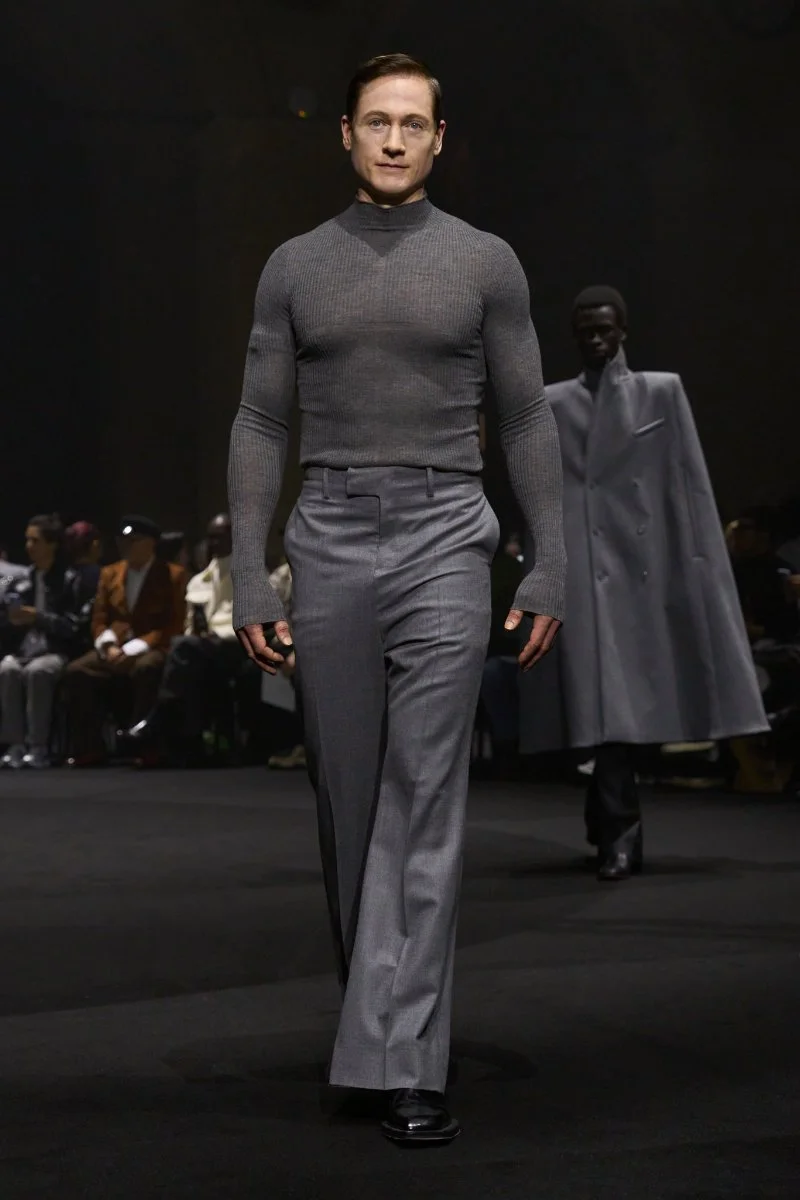
Bryan Johnson, longevity biohacker
The climate: political tension, the political class and the 1%
The diptych lands in a year that business analysts themselves describe as unstable. In January, Esade's Do Better listed five geopolitical risks for 2026, drawn from Angel Saz-Carranza of EsadeGeo (Esade Do Better):
Chinese pressure on EU manufacturing
A volatile US as a trade partner
Leadership changes and political volatility, with the US midterms and Hungary's April elections
Instability around Europe, from Ukraine to the Sahel, Sudan, Syria and Gaza
A possible correction of the AI investment bubble
The same piece notes that political risk now ranks among the top three corporate threats worldwide. It also cites outside forecasts warning of political revolution in Trump's America and a security vacuum in Europe.
Fashion picked up the mood. Reviewing "The One Percent", Fucking Young! linked the theme of power to a new war and a widespread feeling of powerlessness (Fucking Young!). The same review names the industry's own contradiction: fashion serves the one percent and a growing oligarchy while most of the people who make it are not part of either.
That is the bridge between the political class and the 1%. When wealth and political power look interchangeable, an anti-elite runway is no longer a niche provocation. It reads as a mainstream mood, staged in the city's main protest square.
The precedent: Balenciaga's "European Parliament" (SS20)
Note on dates: Demna's European Parliament show was Spring/Summer 2020, presented on 29 September 2019, not Fall/Winter 2020 (FashionUnited).
The show took place in a recording studio in Saint-Denis, north of Paris. The set evoked the chamber of the European Parliament in Strasbourg: a spiral runway washed in EU-flag blue, with guests seated like MEPs. FashionUnited described the atmosphere as ironic and openly critical of European political power.
The critique ran through the details:
Power and money. Suits carried the Balenciaga name on a graphic imitating the Mastercard logo, repeated on fake "VIP" passes, read as a jab at the ties between public and economic power.
Uniforms of authority. Exaggerated shoulders and architectural volumes, mixing 1980s–90s references with the house's archive.
Casting. Bella Hadid walked alongside professionals from fields such as architecture and engineering.
FashionUnited also flagged the contradiction: a house owned by luxury group Kering posing as a critic of the powerful and an ally of working people.
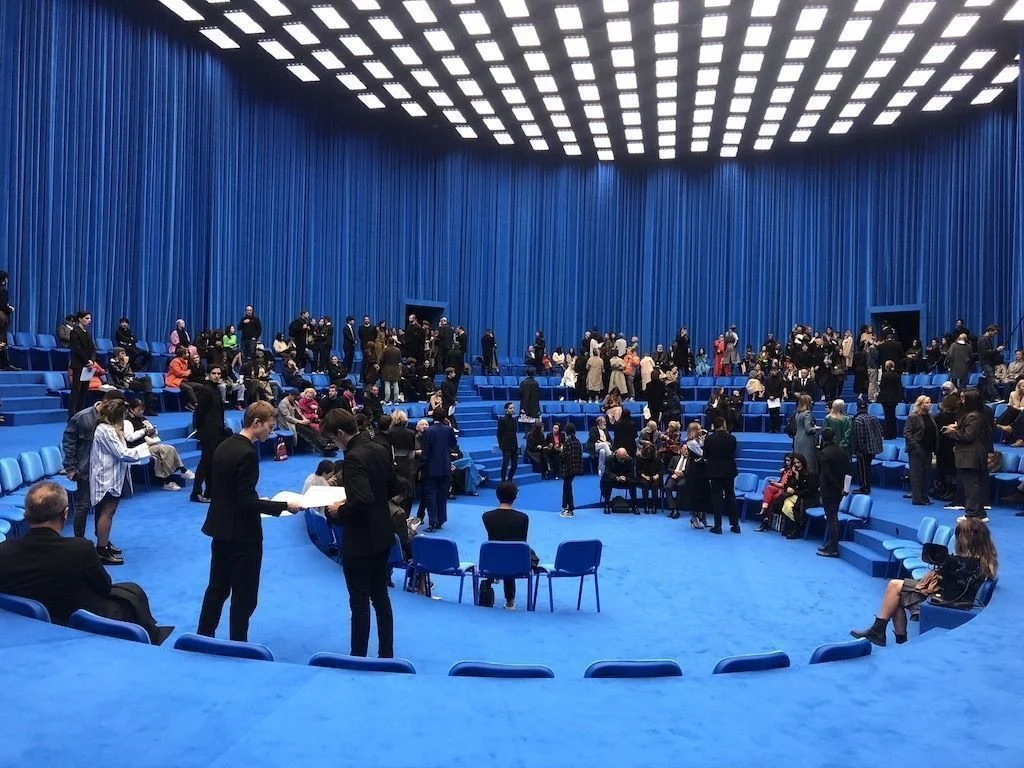
Balenciaga FW2020 Runway
The street outside: the gilets jaunes
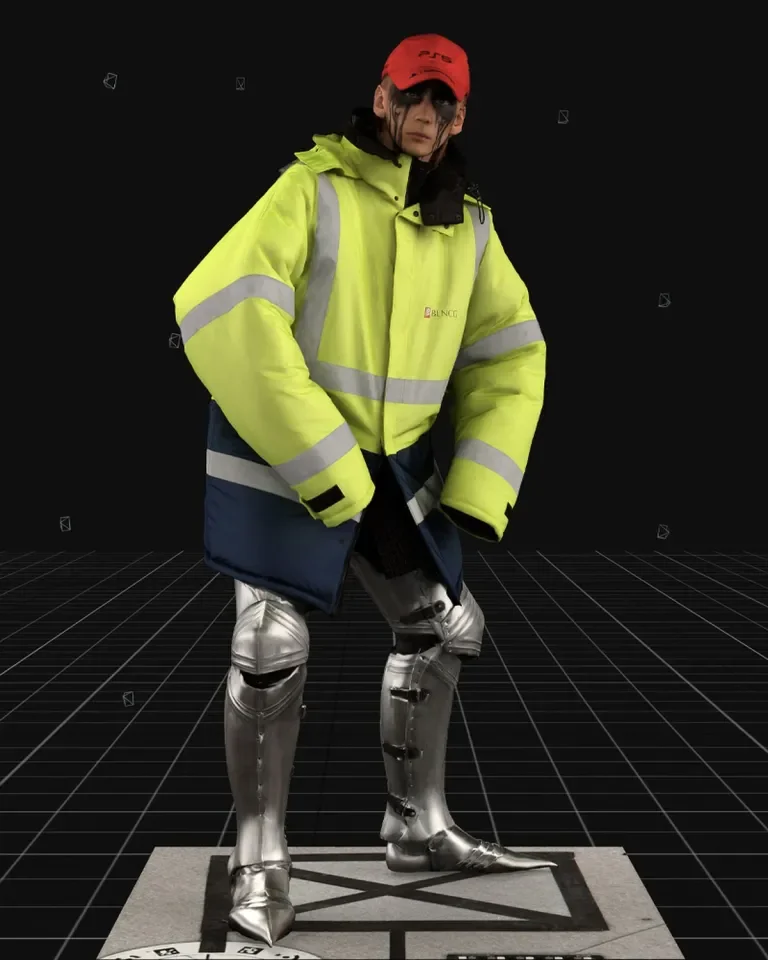
Demna's parliament was not staged in a vacuum. For ten months before the show, France had been shaken by the gilets jaunes. The movement began on 17 November 2018, when nearly 300,000 people protested a fuel tax increase (S-RM). Its uniform was the hi-vis vest every French motorist must carry by law (Participedia).
The fuel tax was the trigger; wealth was the grievance. Macron had cut the wealth tax by roughly 70% in 2017, earning the label "president of the rich" (S-RM). Protesters demanded the tax back, a higher minimum wage and lower salaries for politicians (Wikipedia). At their height, the protests filled the Champs-Élysées with tear gas and shut the Louvre and the Eiffel Tower (The American Prospect).
Against that background, the SS20 show reads differently. Demna framed it around power dressing and the uniform, with "Campaign Dresses" (Vogue Hong Kong) and Mastercard-logo lanyards (FashionUnited). Inside, models played the political class; outside, the counter-uniform was a hi-vis vest. The February 2020 campaign cast models as candidates under empty slogans like "We Vote For Tomorrow" (Highsnobiety). No review I found says Demna referenced the gilets jaunes directly; the link is this article's reading.
Balenciaga dressed the people in power while the street protested outside. Seven years later, Matières Fécales brought the street onto the runway, on Place de la République (Hypebae).
Gilete Jeune by Balenciaga
Analysis: from the parliament to the street
Balenciaga mocked the political class; Matières Fécales went after the class that funds it, then handed the stage to everyone else.
In September 2019, Balenciaga built a replica of the European Parliament in a Saint-Denis studio and aimed its irony at political institutions, using set design and logo parody. In March 2026, Matières Fécales moved the target to the wealthy elite, staging archetypes and props at La Bourse and casting a real billionaire, in a deadpan, ambiguous register. In September 2026, the brand turned the view around: from Place de la République, the 99% looked back at the elite, with 99 models of colour carrying billionaire effigies around the monument in a show that felt like a protest.
Three shifts stand out:
From institution to wealth. Demna staged a parliament. Matières Fécales staged a stock exchange, then a street. The target moved from those who make the rules to those who own the outcome.
From representation to presence. Balenciaga dressed models as power. Matières Fécales cast power itself (Johnson), then cast its own community as the majority.
From closed set to open square. SS27 was the first show ever held on Place de la République (Hypebae). The protest square becomes the runway.
The limits. Both brands face the same contradiction. Balenciaga critiqued power from inside Kering. Matières Fécales grew inside Dover Street Market's incubator (Highsnobiety), and its SS27 front row included Rihanna in a "golden thread knit couture" suit from the brand (The Zoe Report). NSS Magazine titled its SS27 review an "incomplete revolution", arguing the message overshadowed the design (NSS Magazine).
That is the honest reading of "à la guillotine": a symbolic execution, sold to the people it targets. Political fashion rarely changes who holds power. What it can do is make the imbalance visible in the places where power goes to be seen, and Matières Fécales did that more directly than any house since Demna's parliament.
Sources
The New York Times piece on the SS27 show (link) could not be opened here. Nothing in this article relies on it.
Matières Fécales Fall/Winter 2026, Fucking Young!, 4 Mar 2026
Matières Fécales: Ready-To-Wear AW26, 10 Magazine
Matières Fécales FW26, Glamcult
Matières Fécales handed Place de la République to the immigrants for SS27, Hypebae (French edition)
The incomplete revolution of Matières Fécales SS27, NSS Magazine
Rihanna's tinsel skirt suit at Matières Fécales, The Zoe Report
Matières Fécales runway debut, Highsnobiety
Balenciaga atenta contra Europa en su desfile de París, FashionUnited, 30 Sep 2019
2026: A challenging geopolitical landscape for businesses, Esade Do Better, 14 Jan 2026
Bryan Johnson profile, Open
Immortals: Bryan Johnson's new programme, Spider's Web, Feb 2026
The Gilets Jaunes Protests and Macron's Democratic Experiment, Participedia
Yellow vests protests, Wikipedia
France's Yellow Vest Movement, One Year Later, The American Prospect
Balenciaga Spring/Summer 2020 review, Vogue Hong Kong
Balenciaga SS20 campaign, Highsnobiety